Examining Data Patterns in Customizing Access to Multi-Game Environments Spanning Reels, Tables, and Athletic Events Across Varying Jurisdictions
Written by Cameron Otto · Jul 13, 2026
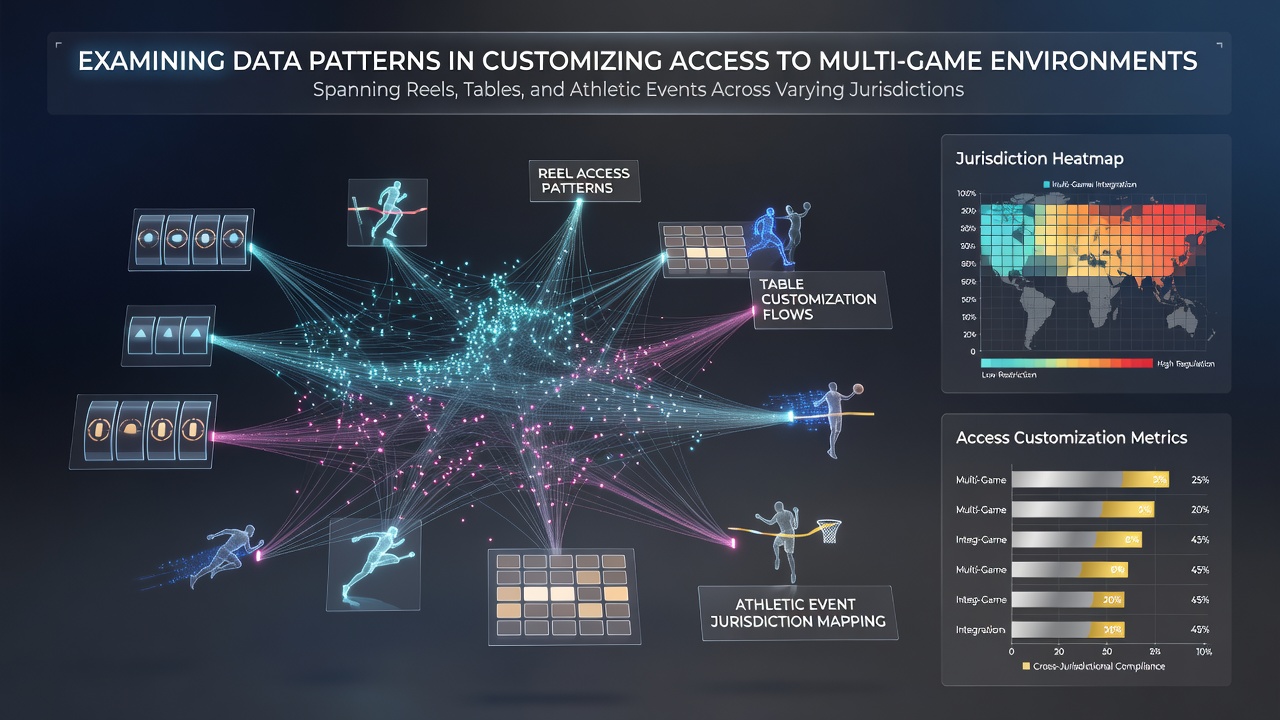
Examining Data Patterns in Customizing Access to Multi-Game Environments Spanning Reels, Tables, and Athletic Events Across Varying Jurisdictions
Data patterns drive customization in multi-game environments that combine reels, tables, and athletic events, and these patterns shift according to regulatory frameworks in each jurisdiction. Operators collect behavioral metrics such as session duration, wager frequency, and game-type transitions, then apply algorithms that adjust interface layouts, bonus eligibility, and access tiers while complying with local data-protection rules.
In the United States, state-level licensing creates distinct data-handling requirements. New Jersey requires real-time reporting of player activity to the Division of Gaming Enforcement, whereas Pennsylvania mandates separate data silos for sports wagering versus casino products. These differences force platforms to segment data flows so that personalization engines respect each state's boundaries without cross-contamination of records.
Core Data Elements Tracked Across Formats
Reel-based games generate high-volume spin data that includes bet size sequences and feature-trigger rates. Table environments produce slower but richer interaction logs such as decision timing and dealer-interaction metrics. Athletic-event platforms add live-market variables including bet placement timing relative to in-game developments. When these streams merge into unified profiles, algorithms identify cross-format patterns such as players who move from slots to live tables after sports losses or those who increase table stakes following reel bonuses.
Jurisdictional Adaptations in July 2026
By July 2026 several markets updated data-governance protocols that directly affect customization engines. Ontario's iGaming framework expanded mandatory data-audit intervals, requiring operators to demonstrate that personalization does not inadvertently promote higher-risk products to vulnerable segments. Australian states introduced granular consent layers that let users toggle data sharing between reel, table, and sports modules independently. European operators outside the United Kingdom adjusted to revised digital-services rules that classify cross-game behavioral profiles as higher-risk processing activities, prompting additional encryption and access-logging steps.
These regulatory updates translate into technical constraints. Platforms must now embed jurisdiction-specific flags inside player records so that a user located in one region receives different recommendation weights than an identical behavioral profile in another region. The result is a layered architecture where global models train on anonymized aggregates while local instances apply jurisdiction-tuned filters.

Integration Techniques and Compliance Mechanisms
Operators deploy graph databases that map relationships between game types and player actions while maintaining geographic partitioning. Each node carries metadata tags that encode regulatory status, allowing queries to exclude or weight data according to active jurisdiction. Machine-learning pipelines run in isolated containers so that training on one market's data does not influence models serving another market.
According to figures published by the New Jersey Division of Gaming Enforcement, cross-format session counts rose 14 percent year-over-year through the first half of 2026, yet responsible-gambling flag rates remained stable when segmentation rules were applied correctly. Similar patterns appear in reports from the Australian Communications and Media Authority, which noted that consent-based data partitioning reduced unauthorized cross-product promotions by 22 percent in licensed platforms during the same period.
Case Examples from Multiple Regions
One operator serving both Michigan and Ontario implemented a unified dashboard that surfaces reel, table, and sports data yet routes each query through separate compliance engines. When a Michigan user completes a sports wager, the system checks state-specific loss-limit thresholds before suggesting table-game bonuses. In Ontario the same sequence triggers an additional self-exclusion database lookup because that province maintains a centralized registry.
Researchers at the University of Nevada, Reno documented how progressive jackpot linkages between reel and table products require synchronized random-number seeding that respects each jurisdiction's RNG certification cycle. Their 2025 working paper showed that platforms updating RNG certificates quarterly experienced fewer synchronization errors than those using annual cycles.
Conclusion
Data-pattern analysis enables precise customization across reels, tables, and athletic events, yet the same analysis must operate within jurisdiction-specific guardrails that continue to evolve. Platforms that maintain partitioned architectures and consent-driven controls demonstrate measurable compliance while still delivering tailored experiences. Continued regulatory updates through 2026 and beyond will further refine the technical requirements for merging multi-format data streams without violating local statutes.